CS409m: Introduction to Cryptography
台☯
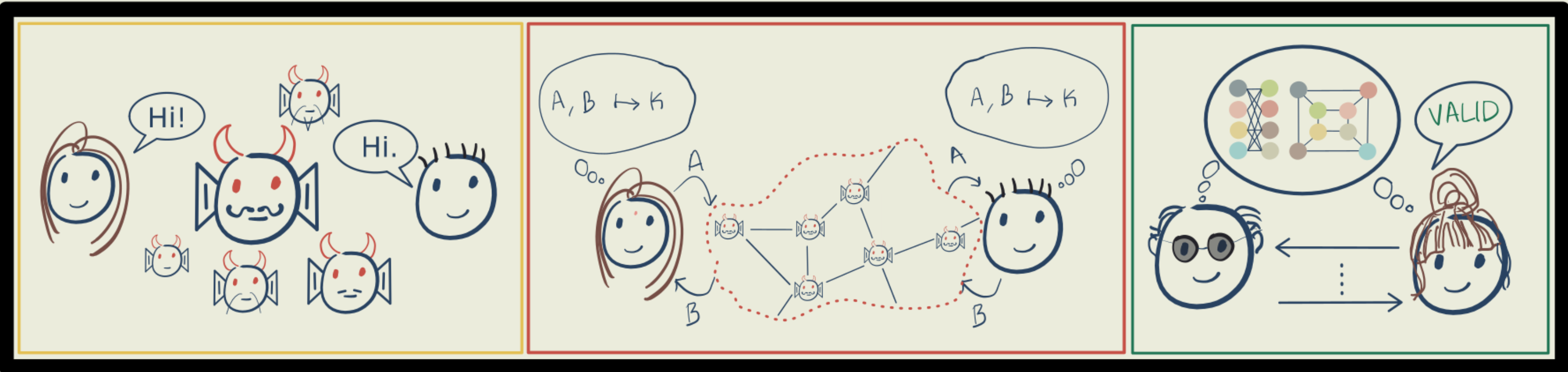
- Instructor: Chethan Kamath
- When and where: Slot 5 (08:00-09:25, Wednesdays and Fridays) in CC101
- Teaching assistants: Shawn Koshy (24B1214), Ravi Prakash (24M2131), Priyanshu Singh (24M2101), Harshit Somani (24B1282) and Reuben Toppo (24B3302)
- Office hours with instructor: After lectures, and by appointment (via e-mail)
- Office hours with TAs: Mondays 17:00-18:00 and Fridays 18:00-19:00 (after polling)
- Announcements and online discussion: Moodle
Overview
Description
Cryptography is the science of securely carrying out tasks (e.g., communication) in presence of adversaries (e.g., eavesdroppers). In this course, we will first study certain basic tasks in cryptography (e.g., secure communication), with an emphasis on precise modelling of the adversary's capabilities and goal -- the threat model -- and formally proving security in this model -- the security proof. Then, we will see how more complex applications you use everyday (e.g., HTTPS, secure messaging, time-based one-time password) can be built on top of these. Additionally, we will also have hands-on sessions aimed at exposing you to real world cryptographic libraries.
Prerequisites
Discrete structures and probability theory are soft prerequisites. This course will involve some amount of theory, and thus we will expect mathematical maturity.
Who can credit?
Since the course is a minor, it is open to all non-CS, non-freshmen UGs.
Grading and Attendance
| Weightage | Towards |
|---|---|
| 35% | End-sem |
| 28% | Mid-sem |
| 20% | Two (out of three) quizzes |
| 10% | Two CTFs |
| 5% | Class participation, pop-quizzes |
| 2% | Feedback |
Attendance is not mandatory (but encouraged). There will be four ungraded assignments to help you with quizzes and exams.
Course Material (Tentative)
| # | Date | Slides | + | Topics Covered |
|---|---|---|---|---|
| L01 | 29/Jul | [↗] | - |
|
| Module I: Secure Communication in the Shared-Key Setting | ||||
| L02 | 31/Jul | [↗] | - |
|
| L03 | 05/Aug | - | [↗] |
|
| L04 | 07/Aug | [↗] | - |
|
| CTF0 | 07/Aug | - | [↗] | "CTF" 0 |
| A1 | 10/Aug | - | [↗] | Assignment 1 |
| L05 | 12/Aug | [↗] | [↗] |
|
| L06 | 14/Aug | [↗] | - |
|
| L07 | 19/Aug | [↗] | [↗] |
|
| Q1 | 19/Aug | [↗] | Quiz 1: 17:00-18:00 in CC101+CC103 | |
| L08 | 21/Aug | [↗] | [↗] [↗] |
|
| CTF1 | 24/Aug | [↗] | CTF 1: due 06/Sep EoD | |
| H | 26/Aug | No lecture: Id-e-Milad | ||
| L09 | 28/Aug | [↗] | [↗] |
|
| A2 | 31/Aug | - | [↗] | Assignment 2 |
| L10 | 02/Sep | [↗] | - |
|
| L11 | 04/Sep | [↗] | [↗] [↗] |
|
| Q2 | 07/Sep | - | [↗] | Quiz 2: 08:15-09:25 in CC103 |
|
|
||||
| L12 | 09/Sep | [↗] | - |
|
| L13 | 11/Sep | [↗] | [↗] |
|
| M | 20/Sep | [↗] | Mid-sem: 14:00-16:00 in TBA | |
| Module II: Secure Communication in the Public-Key Setting | ||||
| L14 | 23/Sep | [↗] |
|
|
| L15 | 25/Sep | [↗] |
|
|
| L14 | 30/Sep | [↗] |
|
|
| A3 | 30/Sep | [↗] | Assignment 3 | |
| H | 02/Oct | No lecture: Mahatma Gandhi Jayanti | ||
| L17 | 07/Oct | [↗] |
|
|
| L18 | 09/Oct | [↗] |
|
|
| Q3 | 14/Oct | [↗] | Quiz 3: 17:00-18:00 in TBD | |
| L19 | 14/Oct | [↗] |
|
|
| CTF2 | 16/Oct | [↗] | CTF 2 | |
| Module III: Applications | ||||
| L20 | 16/Oct | [↗] |
|
|
| L21 | 21/Oct | [↗] |
|
|
| A4 | 23/Oct | [↗] | Assignment 4 | |
| L22 | 23/Oct | [↗] |
|
|
| L23 | 28/Oct | [↗] |
|
|
| L24 | 30/Oct | [↗] |
|
|
| L25 | 04/Nov | [↗] |
|
|
| L26 | 06/Nov | [↗] |
|
|
| E | 14/Nov | [↗] | End-sem: 09:00-12:00 in LA002 | |
Resources
Listed below are the resources relevant to this course. The list of per-lecture resources (e.g., further reading) can be found at the end of the respective lecture slide.
Textbooks- Introduction to Modern Cryptography, by Jonathan Katz and Yehuda Lindell, which we will mostly follow for the first two modules
- Foundations of Cryptography, Volume I by Oded Goldreich
- A Graduate Course in Applied Cryptography by Dan Boneh and Victor Shoup
The following background will be useful to have. However, since this is a minor course, we will gently introduce most of it over the course of the course.
- Basic probability theory, which can be found in §A.3 of Katz-Lindell or the first recitation of MIT6875.
- Basic number theory, which can be found in §B of Katz-Lindell or the third recitation of MIT6875.
- Basic theory of computation and computational complexity, which can be found in the second recitation of MIT6875.
- Foundations of Cryptography (MIT6875) by Vinod Vaikuntanathan
- Cryptography (CS406) by Manoj Prabhakaran