I am currently a post-doctoral researcher at MPI-SWS. So more up-to-date information will be available at my new webpage.
I am pursuing PhD under Prof. Bhaskaran Raman. We seek to develop an Intelligent Transport System (ITS) for developing regions. The horror of road traffic conditions in developing regions can be understood only through experience, but some representative videos can be seen at MumbaiTraffic
The key to obliterate the traffic woes is adding to the road infrastructure, building flyovers at key places, widening roads etc in the same rate as that of traffic growth. But infrastructure growth is slow in developing regions due to lack of funds, space and bureaucratic issues. ITS are parallel efforts, that seek to alleviate the problems, using technology. A typical ITS deployment has the following components -
- Sensing - sensors are placed on the road (dual loop detectors, magnetic sensors, image sensors) or in a set of moving vehicles (GPS, cell phones) to sense various kinds of road data
- Communication - the data is communicated to some central server using GPRS or some other connectivity
- Processing - the data is processed at the central server. Processing might involve classifying the data into various traffic conditions (free flowing/ congested) based on some machine learning algorithms, making travel time predictions etc.
- Application - the processed data is communicated back in the form of some useful information to commuters on the road. What is the congestion scenario at important junctions? Which is the most efficient route between a given source and destination? What is expected travel time between two places? With the boom in cell phone usage, user applications, that can download such information from the central server, are easy to design and deploy.
Overview of work done
- Literature Survey - We have identified three requirements for a traffic sensing technique to work in roads of developing regions. (1) They have to handle chaotic and non-lane based traffic (2) They should not be underground as that would need reinstallation every time a road is relaid, as pavement lifetime in developing regions is low. (3) Installation and maintenance costs and power requirements should be low.
Magnetic sensors and loop detectors definitely don't meet the second and third requirements.Whether they meet the first requirement is open to question as they are generally installed in every lane and detect vehicles per lane. Image sensors meet the second requirement but jointly meeting the first and third requirements seem difficult for them as real-time image processing for chaotic traffic might need costly cameras, more computaion and power. Sensors in vehicles (probes) meet all the three requirements, but the questions of penetration of GPS and smartphones in developing regions, incentivising participatory sensing given energy drain and costs involved in sensing and communication are open. We wrote a workshop paper on these observations in NSDR, 2009.
Literature evolves over time. Since 2009, when I started my PhD, several new works have come into being. Hence the open and interesting set of reserach questions in the context of Indian ITS, has evolved as well. Also, over the past 3 years, we have come in close contact with several practitioners in the field like traffic management authorities and startups, who work in the transportation domain. To give an overview of current state of art for Indian ITS and of practitioners, who can make deployment based research easier, we wrote a second postion paper in NSDR, 2012.
- Sensing - We have developed two new traffic sensing techniques that meet all three requirements and doesn't have the penetration and incentive issues that probe sensors have.
Our first technique is based on sound. Chaotic traffic of developing countries is very noisy. The core of our technique comprises a pair of road side acoustic sensors, separated by a distance. If a moving vehicle honks between the two sensors, its speed can be estimated from the Doppler shift of the honk frequency. In this context, we have developed algorithms for honk detection, honk matching across sensors, and speed estimation. Using over 18 hours of road-side recordings, we show that our speed estimation technique is effective in real conditions. Further, we use our data to characterize traffic state as free-flowing versus congested using a variety of metrics: the vehicle speed distribution, the number and duration of honks. Our results show clear statistical divergence of congested versus free flowing traffic states, and a threshold-based classification accuracy of 70-100% in most situations. We wrote a paper on this in Mobisys, 2010.
Our second technique is based on exploiting the variation in wireless link characteristics when line of sight conditions between a wireless sender and receiver vary. Our system comprises of a wireless sender-receiver pair across a road. The sender continuously sends packets. The receiver measures metrics like signal strength, link quality and packet reception. These metrics show a marked change in values depending on whether the road in between has free-flowing or congested traffic. We have experimented with off-the-shelf IEEE 802.15.4 compliant CROSSBOW Telosb motes. From about 15 hours of experimental data on two different roads in Mumbai, we show that we can classify traffic states as free-flowing and congested using a decision tree based classifier with 97% accuracy. We wrote a workshop paper on this in WISARD, 2011.
In addition to the two novel sensing mechanisms using sound and RF sensors, we have also explored video analysis based traffic sensing for chaotic traffic. This work was done in collaboration with TEM and MNS research groups, at Microsoft Research India. Though the video processing methods are offline, requiring the transfer of videos from the road, and currently we have not explored night vision and automatic camera calibration, our density and speed measurement from video anlysis gives about 11% error compared to manually measured ground truth. And these density and speed values are used in detecting peak traffic hours to possibly incentivize travel time shifts among commuters, and analyze the relations between traffic parameters like speed, density and flow. We wrote a paper on this in ACM DEV, 2013.
- Communication & Processing - For our sound-based technique, we have also examined whether computation intensive acoustic signal processing, be implemented on an embedded sensor platform, to be used for on-road sensing? Can the sensing and processing be done in near real time? Will the cost be low enough? These are some implementability issues. Will the system be able to detect congestion on a wide variety of roads? Will the traffic classification model vary from road to road? In that case, what will be the training overhead of our system on a new road? Can we do without training using unsupervized learning? These are some usability issues.
We have developed an acoustic sensing hardware prototype which has been deployed by the side of the road. This unit samples and processes road noise to compute various metrics like amount of vehicular honks and vehicle speed distribution and sends the metrics to a remote server every alternate minute. Data from deployment of this prototype in six different Mumbai roads, validated against manually observed ground truth, shows feasibility of per minute congestion monitoring from the remote server. K-means clustering gives on average 90% accuracy to group unlabeled data on a new road into two clusters of congested and free-flow. Deployment data from one road for six days shows the temporal variation in traffic state for that road. Our prototype has a moderate cost of $160 and is easy to install and maintain on road-side lamp-posts. We wrote a paper on this in SECON, 2011.
- Novel Sensor Network Applications - Using our RF-based technique, we have designed, implemented and evaluated a sensor network system that can measure traffic queue lengths in real time. Compared to existing systems, it has several advantages: it (a) works in chaotic traffic, (b) does not interrupt traffic flow during its installation and maintenance and (c) incurs low cost. Our contributions in this paper are four-fold. (1) We propose a new mechanism to sense road occupancy based on variation in RF link characteristics, when line of sight between a transmitter-receiver pair is obstructed. (2) We design algorithms to classify traffic states into congested or free-flowing at time scales of 20 seconds with above 90\% accuracy. (3) We design and implement the embedded platforms needed to do the sensing, computation and communication to form a network of sensors. This network can correlate the traffic state classification decisions of individual sensors, to detect multiple levels of traffic congestion or traffic queue length on a given stretch of road, in real time. (4) Deployment of our system on a Mumbai road, after careful consideration of issues like localization and interference, gives correct estimates of traffic queue lengths, validated against 9 hours of image based ground truth. Our system can provide input to several traffic management applications like automated traffic light control, incident detection, and congestion monitoring. We wrote a paper on this in Sensys, 2012.
- Large scale deployment study Use of RF-based sensing poses various practical
questions arising from RF vagaries. First, is sensor training
for traffic-state classification necessary on a per-road basis,
in a city-wide road network? Second, how much manual supervision
is necessary to achieve accurate classification? We have done a large scale datadriven
study to answer such questions regarding practical
deployment of this sensing system. A significant part of our
work has been realistic data collection, on different roads
of varying widths and vehicle types, over a long duration (6
weeks), and with reliable ground truth. We have collaborated
with the Bengaluru city traffic authorities and startup Mapunity to achieve this. Our paper on this has been accepted in IEEE TOSN journal.
Publications
PhD Project:
- Rijurekha Sen, Vishal Sevani, Prashima Sharma, Zahir Koradia, Bhaskaran Raman, "Challenges In Communication Assisted Road Transportation Systems for Developing Regions", 3rd ACM Workshop on Networked Systems for Developing Regions (NSDR'09), a workshop in SOSP'09, Big Sky, Montana, USA, 11 Oct 2009. paper, ppt
- Rijurekha Sen, Bhaskaran Raman, Prashima Sharma, "Horn-Ok-Please", The 8th Annual International Conference on Mobile Systems, Applications and Services, Mobisys'10, San Francisco, USA, Jun 15-18, 2010. paper, ppt
- Swaroop Roy, Rijurekha Sen, Swanand Kulkarni, Purushottam Kulkarni, Bhaskaran Raman, Lokendra Singh, "WirelessAcrossRoad: RF based Road Traffic Congestion Detection", The 5th Annual Worshop on Wireless Systems: Advanced Research and Development (WISARD'11), Bangalore, India, Jan 4-5, 2011. paper, ppt
- Rijurekha Sen, Pankaj Siriah, Bhaskaran Raman, "RoadSoundSense: Acoustic Sensing based Road Congestion Monitoring in Developing Regions", 8th Annual IEEE Communications Society Conference on Sensor, Mesh and Ad Hoc Communications and Networks, SECON'11, Salt Lake City, Utah, USA, Jun 27-30, 2011. paper
- Rijurekha Sen, Bhaskaran Raman, "Intelligent Transport Systems For Indian Cities", 6th ACM Workshop on Networked Systems for Developing Regions (NSDR'12), a workshop in USENIX ATC'12, Boston, MA, USA, 15 Jun 2012. paper, ppt
- Rijurekha Sen, Abhinav Maurya, Bhaskaran Raman, Rupesh Mehta, Ramakrishnan Kalyanaraman, Nagamanoj Vankadhara, Swaroop Roy, Prashima Sharma, "KyunQueue: A Sensor Network System To Monitor Road Traffic Queues", 10th ACM Conference on Embedded Networked Sensor Systems, SenSys'12, Toronto, Canada, Nov 6-9, 2012. paper, ppt
- Rijurekha Sen, Abhinav Maurya, Bhaskaran Raman, Amarjeet Singh, Rupesh Mehta, Ramakrishnan Kalyanaraman, "Road-RFSense: A Practical RF-Sensing Based Road Traffic Estimation System for Developing Regions", Transactions on Sensor Networks, TOSN, (accepted for publication). paper
Internship at Microsoft Research, Bangalore, summer 2011:
- Anshul Rai, Krishna Chintalapudi, Venkat Padmanabhan, Rijurekha Sen, "Zee: Zero-Effort Crowdsourcing For Indoor Localization", The 18th Annual International Conference on Mobile Computing and Networking, Mobicom'12, Istanbul, Turkey, Aug 22-26, 2012. paper
Internship at Microsoft Research, Bangalore, summer 2012:
- Rijurekha Sen, Andrew Cross, Aditya Vashishtha, Venkata N. Padmanabhan, Edward Cuttrell, William Thies, "Accurate Speed and Density Measurement for Road Traffic in India", 3rd Annual Symposium on Computing for Development, DEV'13, Bangalore, India, Jan 11-12. paper, ppt
Weekend work at startup effort Triplaud, summer 2012:
- Rijurekha Sen, "RasteyRishtey: A Social Incentive System to Crowdsource Road Traffic Information In Developing Regions", The Seventh International Conference on Mobile Computing and Ubiquitous Networking, ICMU'14, Singapore, Jan 6-8, 2014. paper
Research engineer at SMU Livelabs, since Feb 2013
- Rijurekha Sen, Rajesh Krishna Balan, "Challenges and Opportunties in Taxi Fleet Anomaly Detection", The First International Workshop on Sensing and Big Data Mining, SenseMine'13, a workshop in SenSys'13, Rome, Italy, Nov 14, 2013. paper
BTech Project:
- Pampa Sadhukhan, Dr. Pradip K. Das, Rijurekha Sen, Niladrish Chatterjee, Arijit Das, "A Middleware-Based Approach to Mobile Web Services", The 5th Asian International Mobile Computing Conference, AMOC-2007. paper
- Pampa Sadhukhan, Rijurekha Sen, Pradip K. Das, "A Middleware Based Approach to Dynamically Deploy Location Based Services Onto Heterogeneous Mobile Devices Using Bluetooth in Indoor Environment", The 2nd International Conference on Advanced Communication and Networking. ACN'10, Miyazaki, Japan, June 23 - 25, 2010. paper
Posters
- Rijurekha Sen, Prashima Sharma, Bhaskaran Raman, "Horn-Ok-Please", Microsoft Techvista PhD Poster Session, 2010, Banglaore, 22 Jan. We won the 4th prize, worth Rs. 25,000. pdf,ppt
- Rijurekha Sen, Pankaj Siriah, Bhaskaran Raman, Swaroop Roy, Swanand Kulkarni, Puru Kulkarni, "Fighting Chaotic Road Congestion", Microsoft Techvista PhD Poster Session, 2011, Pune, 21 Jan. pdf
- Rijurekha Sen, Abhinav Maurya, Bhaskaran Raman, "KyunQueue: A Sensor Network System To Monitor Road Traffic Queues", Microsoft Techvista PhD Poster Session, 2012, Kolkata, 20 Jan. We won the 2nd prize, worth Rs. 75,000. poster
Awards
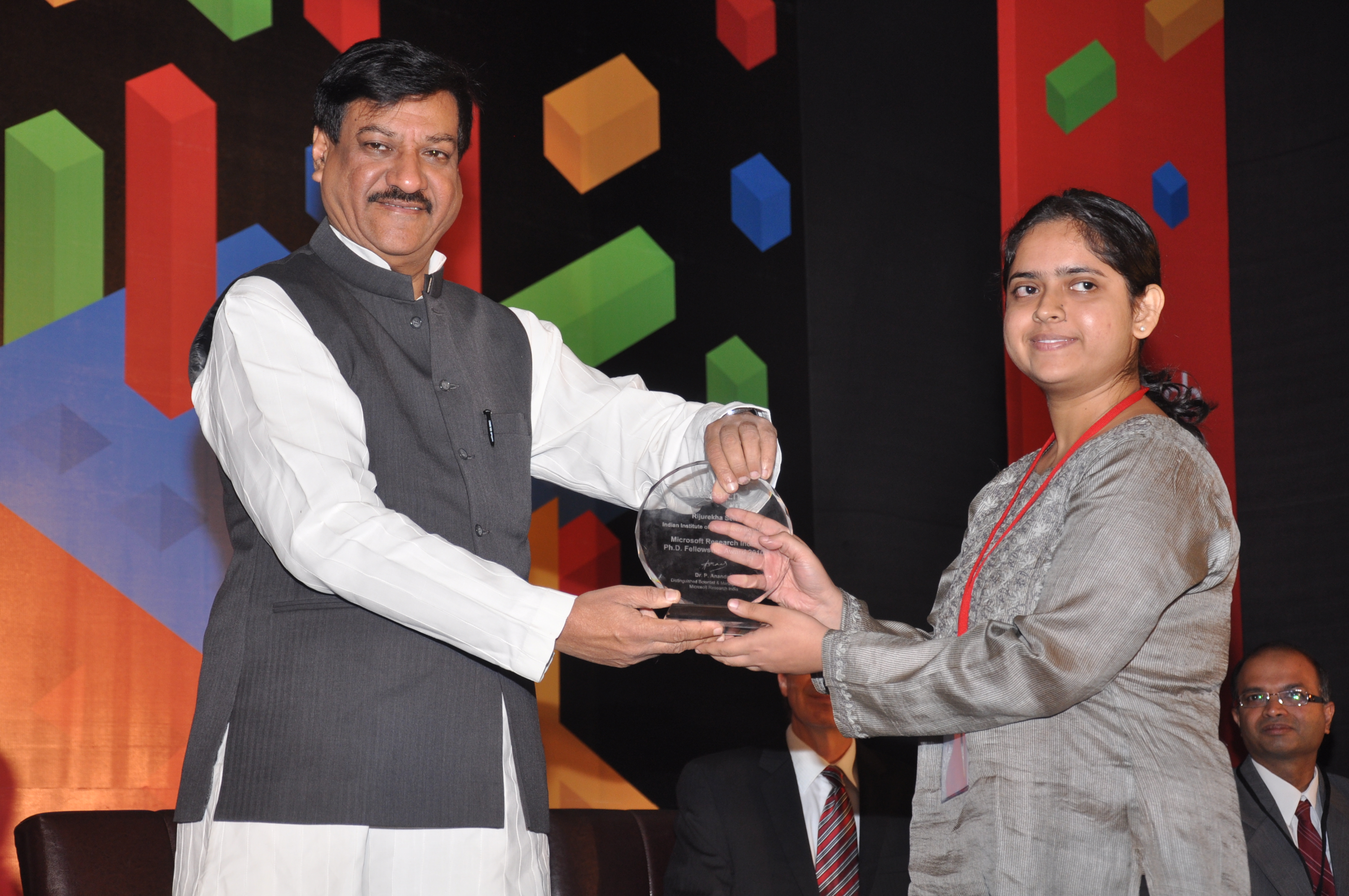
- Microsoft Research India gives five PhD fellowships every year to graduate students in India based on resume and three recommendations. There were 50 applications in 2010 and mine was one of the selected five. In course of my PhD, I am eligible to get a laptop, a monthly stipend and Rs. 2.5 lacs for foreign trips. This will also ensure increased interaction with the researchers at MSR India and taking part in the various events organized by them. More details of the award are at msr_phd_fellowship. You can see a photo of mine, taking the award from Mr. Prithviraj Chauhan, Chief Ministerof Maharashtra.
- I received the Google Anita Borg Scholarship Asia Pacific, 2013. More details about the award can be found at Google student blog and here is a video of the scholars' retreat at Google Sydney.
Reports
- I gave my first Annual Progress Seminar (APS) on 27 Jan, 2010. report, ppt.
- I gave my second Annual Progress Seminar (APS) on 27 Jan, 2011. report, ppt.
- I gave my third Annual Progress Seminar (APS) on 26 Jan, 2012. report.
- I gave my pre-synopsis seminar on 13 Jan, 2013. External examiners Vikram Srinivasan from Alcatel Lucent, Prof. Ramesh Govindan from USC and Dr. Venkat Padmanabhan from Microsoft Research India have given valuable comments Reviews 1 and 2, Review 3 on my thesis. I successfully defended my PhD thesis on Jan 10, 2014 and received the doctoral degree in convocation, Aug 2014. synopsis, thesis