


When I was in high school, we used to think of Algebra as
``Mathematics of letters rather than of numbers''. This was because
unlike arithmetic, the solution to problems in algebra began with
``Let  denote the ...'', after which it would be necessary to
figure out what happens when this letter was subjected to
different multiplications, additions etc. But why do we need to learn
this ``Mathematics involving letters''? Isnt it sufficient to learn
how to work with numbers? These are some of the natural questions
that may arise in your minds, and so I will try to answer them.
denote the ...'', after which it would be necessary to
figure out what happens when this letter was subjected to
different multiplications, additions etc. But why do we need to learn
this ``Mathematics involving letters''? Isnt it sufficient to learn
how to work with numbers? These are some of the natural questions
that may arise in your minds, and so I will try to answer them.
The main reason for studying algebra is as follows. Very often, a certain number or set of numbers is not explicitly given to you, but instead you are given the relationships of those unknown numbers among themselves or with some known numbers. Can you then find the unknown numbers? How to reason about such numbers and if possible find their value is the central question dealt with in Standard X algebra. Questions of this kind arise frequently in science and engineering as well as day to day life.
This chapter will give you an overview of what you will learn in this book. First, you will see some problems that you will be able to solve after you have studied the rest of this book. You will realize as soon as you read the problems that they cannot be solved using what you have learnt till standard IX. These problems are certainly harder, but perhaps you will also think that they are more interesting. The second goal for this year is to understand the use of Algebra in other sciences such as Physics. Algebra is heavily used in physics and other sciences and engineering, (as well as economics) and so we will learn how it is used. Third, you will learn the relationship between Geometry and Algebra. Indeed, you can use algebra to solve geometric problems (even prove theorems!) and use geometry to better understand Algebraic equations.
Finally, you will also learn a whole lot of new words and phrases during the year - the last section will say a bit about this.
Suppose I own a plot of land of size 10 m  15 m. Suppose I
wish to construct a house in it having area 100 sq m. The area of the
plot is 150 sq m., so that the house will be certainly accomodated and
some space will be left. I would like to build the house in the shape
of a rectangle in the middle of my plot. Further, I think it will
look nice if each wall is at the same distance from the corresponding
edge of the plot. In other words, if the house is built as shown in
the picture, all the distances shown by arrows should be the same. So
how much distance should I leave to the edges of the plot?
15 m. Suppose I
wish to construct a house in it having area 100 sq m. The area of the
plot is 150 sq m., so that the house will be certainly accomodated and
some space will be left. I would like to build the house in the shape
of a rectangle in the middle of my plot. Further, I think it will
look nice if each wall is at the same distance from the corresponding
edge of the plot. In other words, if the house is built as shown in
the picture, all the distances shown by arrows should be the same. So
how much distance should I leave to the edges of the plot?
Suppose I leave a distance of 1 meter from each wall and build my
house. How much area will it have? Since the length of the plot is
15 m, the length of the house must be 13 m after leaving 1 m on each
side. Since the width of the plot is 10 m, then with 1 m left on each
side the width of the house will be 8 m. The area of the house then
is
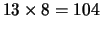 sq m. This is a bit more than I want. So suppose
I leave a distance of 2 m from each side. Then the length and width
of the house respectively will become 11 m and 6 m, with an area of 66
m. So the distance that I should leave between the walls and the edge
should be less than 2 m, but more than 1 m. The question is, can we
find this distance exactly?
sq m. This is a bit more than I want. So suppose
I leave a distance of 2 m from each side. Then the length and width
of the house respectively will become 11 m and 6 m, with an area of 66
m. So the distance that I should leave between the walls and the edge
should be less than 2 m, but more than 1 m. The question is, can we
find this distance exactly?
This problem is different and harder than the problems you have encountered so far, i.e. until standard IX. Nevertheless, it is possible to write down an algebraic equation which represents the information given above and solve it and this will tell us what distance to leave between the walls and the edge of the plot. The type of equations that we will need to write are called quadratic equations, and we will learn these in Chapter 6.
Although you dont know the method of solving the problem exactly, try
to find a good approximate answer. This can be done by continuing the
procedure we started above. We saw that the distance between the
walls and the edge of the plot must be less than 2 m but more than 1
m. The upper limit that we have on the answer and the lower limit
differ by  m. This is called ``Knowing the answer to within a
range of 1 m.'' The question is can you reduce the range further? If
you can decide whether the answer should be between 1 m and 1.5 m or between
1.5 m and 1 m - then you would have narrowed the range to 0.5 m.
m. This is called ``Knowing the answer to within a
range of 1 m.'' The question is can you reduce the range further? If
you can decide whether the answer should be between 1 m and 1.5 m or between
1.5 m and 1 m - then you would have narrowed the range to 0.5 m.
Can you continue in this manner and determine the answer to within a range of 1 cm?
Of course, if I eat 1 kg of each, I will get the
more than the required amount of protein and carbohydrate. However,
that is eating too much- that is also bad for your health. Suppose I
decide to eat 0.5 kg of rice and 0.5 kg of wheat. Then I will get
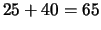 gm of protein, and
  gm of carbohydrate. This
is enough carbohydrate, but too much protein. So what should I eat?
gm of carbohydrate. This
is enough carbohydrate, but too much protein. So what should I eat?
In Chapter 5 you will learn methods to solve such problems.
Eating 0.5 kg of each gives you the correct amount of carbohydrate but too much protein. So reducing both rice and wheat wont work - that will reduce protein, but also the carbohydrate. So what should you do? What if we increase rice and decrease wheat? Continue in this manner and you can get closer and closer to the correct answer.
Algebraic reasoning is routinely used in solving problems in Physics, Chemistry, Engineering and Economics. As an example, let us see a problem from Physics.
Our classroom has a lamp in which there is a 60 watt bulb at the center. Every one sits within a distance of 3 meters from the bulb, and can read comfortably. Suppose now that some more students are to sit in our room. Of course, this means that some of them will have to sit further from the lamp. Suppose that with the new students everyone can sit within a distance of 6 m. But now, the light is too dim for the students sitting at the distance of 6 m. Can you find out what wattage bulb you need so that even the student sitting far away can read comfortably?
This problem is very different from the previous two problems because you need to know something about the physics of light bulbs. More precisely, you need to know the following: How does the light given out by a bulb increase as I increase the wattage of the bulb? For example, if I double the wattage, does the light double? As I go away from the bulb, how does the intensity of the light that I receive increase or decrease? For example, if I go and sit at double the distance, will I receive half as much light?
The laws regarding how the amount of light produced varies with the wattage, as well as the law about how much light is received at what distance from the lamp are studied in physics. But the language for expressing these laws is the language of algebra! So algebra is very essential for studying and using physics to solve problems. In this book, we will learn how physical laws are expressed using algebra, and using these laws how we can solve problems such as the one given above. Our goal here is not to study the behaviour of light or electricity - that is the subject of physics. Our concern will only be how to express physical laws in the language of algebra, and subsequently use the laws.
Suppose we know from physics that (1) The amount of light falling on my book doubles if I double the wattage of the lamp, without changing the distance between the book and the lamp (2) The amount of light falling on the book halves if the bulb wattage is kept unchanged but I move the book to twice the distance from the bulb. Law 1 described above is correct, but law 2 is actually incorrect from the point of physics. Let us however assume that both laws are correct for the minute. Can you then figure out what the wattage of the bulb should be when the students sit at 6 m in the problem given above? What if the students have to sit at 12 m?
It turns out that Algebra is very useful while solving problems in Geometry and vice versa. You might be surprised by this; after all algebra appears to be a game of words, while geometry a game of pictures. But diagrams such as the ones we draw in Geometry can help us in visualizing algebraic equations (and other information that can be specified algebraically). Likewise, geometric objects can be represented using algebraic equations. Thus questions regarding geometric pictures (e.g. ``do these lines intersect?'') can be transformed into questions regarding equations (e.g. ``Does this equation have a solution?'').
The Geometry you learn in school concerns figures that can be drawn on the plane, and is in fact called Plane Geometry. But later on, in college, you will learn Solid Geometry, which concerns solid objects: instead of circles and squares and triangles of Plane Geometry, Solid Geometry is concerned with spheres, and cubes and other solid figures. Most people find it hard to visualize questions from solid Geometry (``What is the shape that results when a cube intersects with a sphere?''). So Solid Geometry is commonly studied by using Algebraic techniques. You will have to wait till college to do this. For now it is enough to properly understand Algebra.
Learning new words/phrases is an important part of learning any subject. For example, while learning biology we might be introduced to words such as ``cerebellum'', ``digestive system'', while learning physics we might have to learn words such as ``momentum''. New words/phrases must also be learnt while learning mathematics.
The new set of words/phrases you will learn in Standard X algebra are mostly concerned with describing the relationships between numbers. One such word that you have already learnt in Standard IX is ``ratio''. In this book we will study more properties of ratios. We will also learn other words/phrases.
We study new words and phrases firstly because they allow us to express our thoughts compactly, for example it is shorter to say, ``the ratio x to y'', rather than saying ``the number obtained when x is divided by y''. But more than compactness, new words and phrases express new concepts. Thus in defining the word ``ratio'', we are acknowledgeing that dividing a number by another is a good way to compare them. In other words, the objective in using the word ratio is used to alert the reader that two numbers are being divided for the purpose of comparing them.
In Standard X algebra, we will learn new techniques for solving problems. Using these techniques we will be able to solve harder and more interesting problems. We will also study how Algebra can be used to describe physical laws, and how it is used in Science and Engineering. Finally, we will study some relationships between Algebra and Geometry.