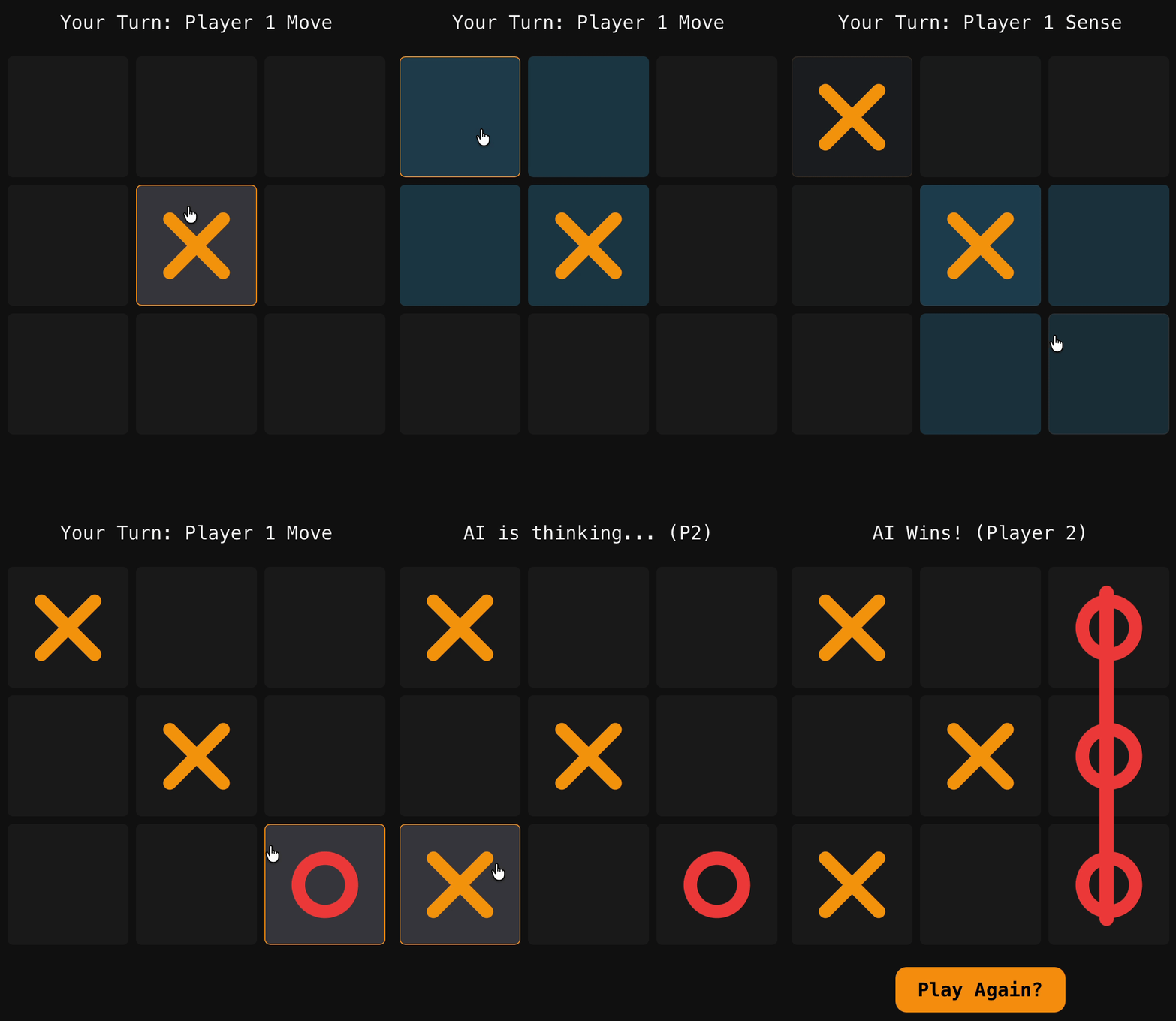
Created by Anvay Shah; play Reconnaissance Blind Tic-Tac-Toe.
(Page last edited .)
Lectures will be held in CC 101 during Slot 14: 5.30 p.m. – 6.55 p.m. Tuesdays and Fridays.
The instructor will be available for consultation immediately following class, up to 7.30 p.m., on both Tuesdays and Fridays. He will also hold office hours (220, CC Building) 8.45 a.m. – 9.45 a.m. Wednesdays.
Artificial intelligence is fast making inroads into various fields, and is indeed influencing our lives in a telling way. This course will accustom students to the state-of-the-art in designing and deploying intelligent and learning agents. The course will build upon the platform laid by CS 747 (Foundations of Intelligent and Learning Agents) to engage students in targeted research and system-building projects.
The course has three main objectives. First, it seeks to impart students the mindset that artificial intelligence and machine learning can substantially benefit real-world problems, and give them the confidence that they can drive this process. Second, the course seeks to develop the students' skills to abstract, analyse, design, implement, evaluate, and iterate while devising solutions. The third objective of the course is to train students to comprehend technical discourse and sharpen their communication skills.
The course is organised in the form of two parallel tracks: class discussions based on research papers, and a semester-long research project. Students will be provided a reading assignment every class, and will be expected to turn in a response summarising their understanding and related observations. Individual responses will be shared with the class, and will guide the class discussion. Topics covered in the reading assignments will include, among others, multiagent learning, POMDPs, RL in generative AI, theoretical analysis of MDP planning and learning, representation discovery, exploration, abstraction, animal behaviour, evolutionary algorithms, philosophy of AI, and applications.
The research project presents an opportunity to students for applying their learning in creative and imaginative ways to understand, build, and analyse systems. Both theoretical and empirical investigations may be undertaken. Students may work alone or in teams (of size up to three). Each team will be guided individually through the phases of the research project, but will share its progress with the class at designated intervals.
The course is open to students who have taken CS 747 (any previous offering) and secured a passing grade (DD or above).
Class discussions will carry 45 marks, of which 35 marks will be for written responses to the reading assignments, and 10 marks for contribution to class discussions.
Each reading assignment will be for 3 marks; at least 15 reading assignments are expected to be administered through the semester. The marks from these assignments will be added and capped at 35 to obtain their contribution to the course total.
Students are expected to speak up in class and contribute to the group discussion on a regular basis. They will receive feedback and marks (out of 5) once after the first half, and again after the last class meeting. Absence from class (unless due to documented medical leave) will result in a proportional reduction of marks. A response to a reading assignment will not be graded unless the student is present in class when the reading is discussed.
The research project will carry 55 marks, divided as: 5 marks for an introductory presentation, 5 marks for a proposal, 10 marks for a mid-stage presentation, 10 marks for the final presentation, and 25 marks for the final report. An outstanding research project will bypass the regular evaluation criteria and automatically result in an "AA" grade for the concerned team.
The course does not have any tests or programming assignments.
All submissions must be made through Moodle.
Students auditing the course must score 50 or more marks in the course to be awarded an "AU" grade.
A reading assignment will typically require the student to read and summarise a paper (that will come up for discussion in class subsequently). The response is expected to be about two pages long, written by hand with pen and paper, then scanned into a pdf and uploaded to Moodle. Material created by typing or using electronic media (such as digital pad and stylus) will not be accepted.
The response is meant to function as an informative summary of the paper. It must bring out the main claims of the paper, the significance of the results in the context of related work, the methodology proposed, the soundness of the evaluation of the idea, and so on. The response must also identify potential weaknesses and shortcomings of the paper, draw connections with ongoing research/applications, and outline the potential for future work. Additionally, students are encouraged to include their own questions about the material in their responses.
The most effective way to prepare a response is to take down notes while reading (and perhaps re-reading) the paper, and then to collate the notes into a cogent sequence (which might again need a few iterations). The form of the response must be a few (typically 4–6) paragraphs arranged in a natural sequence. Full sentences must be used: no "bullet points" or "short notes".
Students must not consult LLMs in any manner while preparing their responses. The exercise is meant to hone their own skills at assimilating and communicating; any external shortcuts negates the sanctity of this exercise.
In general, LLMs must not be used in any form for preparing any written submission for the course (that is, responses to readings, project proposal, mid-stage report, and final report).
On the other hand, the students are free to use LLMs for coding or any other aspect of their research while working on their course project. They should declare this usage in their written submissions.
Students are expected to adhere to the highest standards of integrity and academic honesty. Academic violations, as detailed below, will be dealt with strictly, in accordance with the institute's procedures and disciplinary actions for academic malpractice.
Students may freely collaborate with their peers towards their research projects, but any assistance received from colleagues must be properly acknowledged in the corresponding presentations and reports. Failure to list any source used in responses to reading assignments will be considered an academic violation.
Students are allowed to verbally discuss the readings with their peers. However, they must not view, access, or consult any others' written responses. It is all right to read related papers from the published literature, blogs, and so on. However, students must cite every resource consulted or used, as a part of their response itself. As stated earlier, LLMs must not be consulted in any manner for preparing any written submission.
Students may use existing code and libraries towards their research project, and also use LLMs for assistance with coding and research (for example to discover relevant papers). However, students must take care to provide appropriate attribution in the relevant reports. Failure to list any resource used will be considered an academic violation.
If in any doubt as to what is legitimate collaboration/usage of AI tools and what is not, students must ask the instructor.
This page will serve as the primary source of information regarding the course, the schedule, and related announcements. The Moodle page for the course will be used for sharing resources for the lectures and assignments, and also for recording grades.
E-mail is the best means of communicating with the instructor; students must send e-mail to "shivaram@cse.iitb.ac.in" with "[CS748]" in the header.