CS 721: Introduction to Complexity Theory
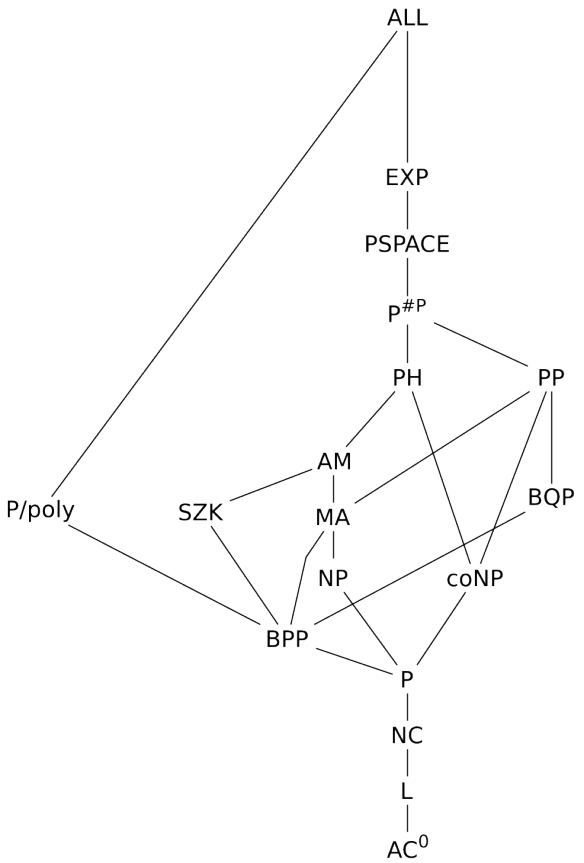
Known relationships between complexity classes
This course is a hike through the complexity zoo, with detours into different landscapes — space complexity, circuits, randomness, interactive proofs — and a look at how they connect. We begin with Turing machines and the classes P and NP, develop reductions and completeness, and work outward from there.
The main objective is a complexity-theoretic view of computation: how to formalize it, how to compare problems, and why establishing limits has proved so stubbornly hard.
| Prerequisites | A solid undergraduate background in algorithms, discrete mathematics and general mathematical maturity. Some familiarity with the theory of computation (Turing machines, P and NP) will be helpful but not required. |
| Teaching Assistants |
Aditya Neeraje (23b0940 [at] iitb [dot] ac [dot] in) Pavankumar N (25m0803 [at] iitb [dot] ac [dot] in) |
| Contact | vishwas [at] cse iitb [dot] ac [dot] in |
| Quiz / Assignment 7 total, best 5 counted — every other Friday |
25% |
| Mid-sem exam | 30% |
| End-sem exam | 45% |
| Paper presentation Bonus |
+20% |
| 1 |
Assignment 1 (PDF)
Tested in class on Fri, Aug 7, following a discussion / doubt-clearing session.
|
| 2 |
Assignment 2 (PDF)
Tested in class on Fri, Aug 21.
|
| 3 |
Assignment 3 (PDF)
Tested in class on Fri, Sep 4.
|
Lectures 1–2 · Lecture 3 onwards (running notebook, GoodNotes, view-only)
| Date | # | Topic |
|---|---|---|
| Tue, Jul 28 | 1 |
Introduction
Administrivia; problems of interest; Turing machines
|
| Fri, Jul 31 | 2 |
P, NP, and reductions
Definitions of P and NP; polynomial-time reductions
|
| Tue, Aug 4 | 3 |
Cook–Levin theorem and NP-hardness
Cook–Levin theorem; NP-hardness reductions
|
| Fri, Aug 7 | 4 |
Assignment 1 quiz
Discussion / doubt-clearing session, followed by the in-class test
|
| Tue, Aug 11 | 5 |
The art of reductions
Special lecture on designing NP-hardness reductions
|
| Fri, Aug 14 | 6 |
coNP and the time hierarchy theorem
Padding argument; coNP; the (deterministic) time hierarchy theorem
|
| Tue, Aug 18 | 7 |
Ladner's theorem and relativization
Ladner's theorem (NP-intermediate problems); the relativization barrier
|
| Fri, Aug 21 | 8 |
Assignment 2 quiz
In-class test, followed by the proof of the Baker–Gil–Solovay theorem
|
| Tue, Aug 25 | 9 |
Space complexity: PSPACE
Configuration graphs; space complexity classes; PSPACE-completeness (TQBF)
|
| Fri, Aug 28 | 10 |
Logspace complexity: L, NL
Logspace reductions; NL-completeness
|
| Tue, Sep 1 | 11 |
NL = coNL, and the polynomial hierarchy
The Immerman–Szelepcsényi theorem; the polynomial hierarchy (PH)
|
| Fri, Sep 4 | 12 |
Assignment 3 quiz
In-class test, followed by more on alternation and the polynomial hierarchy
|
| Tue, Sep 8 | 13 |
Boolean circuits
Boolean circuits and circuit families; P/poly
|
| Fri, Sep 11 | 14 |
Parallel computation and NC
Definition of NC and related circuit classes
|
| More lectures to be added as the course progresses. | ||